Celebrating 10 Years of Santa Barbara Ice Hawks Hockey
Nobody Plays Hockey in
Santa Barbara by Accident
Celebrating 10 Years of Santa Barbara
Ice Hawks Hockey
2016 – 2026
A Cafe Table and a Crazy Idea
Ten years ago, a group of parents sat down at a table in the Ice in Paradise cafe and decided Santa Barbara should have a youth hockey club. Nobody at that table had started one before. They sorted out who would be president and who would handle the paperwork, worked out the rest as they went, and put three teams on the ice that spring.
Those three teams were all B-level. Today the Santa Barbara Ice Hawks have league and state championship banners at every age level, a pipeline that takes kids from their first wobbly steps on skates to a travel jersey, and a reputation across Southern California as one of the most respected clubs in the region.
This is the story of how it happened.
From Wheels to Blades
Before there was a club, there was a rink, and before the rink there was roller hockey.
Johan Frisell had been coaching Santa Barbara roller hockey for about six years when word got out that an ice rink was finally coming to Santa Barbara. “When everyone heard the rink was coming, everyone was super excited,” he said. As soon as Ice in Paradise opened, Johan and a small group of volunteers started running an informal in-house group, teaching former roller hockey kids from about age seven up to fourteen how to play the game on ice. Johan had grown up playing hockey in Sweden, and now he was watching kids who had been great on wheels fall all over themselves on blades.
“You’d see a kid who could fly on roller skates just go down in a heap. And then a month later they’re flying again.”
Johan Frisell, Treasurer
Steve Heinze knows what the game looks like at the very top. A Boston College standout, a member of the 1992 U.S. Olympic team, and a 13-year NHL veteran playing with the Boston Bruins and Los Angeles Kings, he had settled in Santa Barbara and been part of the push to get the rink built in the first place. Once it existed, the question was what to do with it. “We got the rink built and then it was, okay, what are all the things we want to do here?” he said. Steve thought back to his own childhood, when his father led the local youth hockey league, and to all the people who had helped him get where he got. “So my thing always was, how do I give back? What can I do to pay that forward in Santa Barbara?”
The answer took shape at that cafe table, where those early parents, whose kids had been driving to Oxnard to play, put the idea on the table directly: Santa Barbara should have its own club. “We never had done it before,” Johan said. “We passed the roles around, who wants to be president, who wants to do registrations. People just ran with it pretty strong in the beginning, and we kind of figured it out as we went.”
Steve’s lane was clear from the start. “I know the on-ice side,” he said. “That’s where I could help most. Get on the ice, coach the kids, and help our coaches get better at coaching them.” He has done exactly that for ten years, serving as the club’s Director of Coaching, getting on the ice with kids, running clinics for the coaching staff and lending an NHL-level eye to how the Ice Hawks teach the game at every age.
Three Teams and a Litmus Test
The club’s first real test was a Memorial Day tournament in the spring of 2016. Steve calls it the litmus test: what do we actually have here? The answer was three viable teams, a bantam (14U), a peewee (12U), and a squirt (10U), assembled from three very different kinds of players. Some were roller hockey kids making the switch. Some had been driving to Oxnard for years and were glad to finally have a home rink. And some, as Steve put it, were “ankle benders” playing organized hockey for the very first time.
That first Memorial Day tournament was a success by the only metric that mattered. The kids had a blast and were hungry for more. So in the fall of 2016, the Ice Hawks were a registered Southern California Amateur Hockey Association (SCAHA) club playing a full travel schedule.
Nobody expected what happened next. Johan’s bantam team, registered at the B level, ran through an early-season tournament and won it outright. “We had absolutely no idea,” he said. “We had signed up to play B hockey and these kids were really good players. We begged, please move us up to A.” The league said no, at least until the scores made the case impossible to ignore. The team was moved up mid-season, played the rest of the year at the A level, and made the playoffs.
For a brand-new club in a town where hockey had never been a given, that first season mattered more than the wins. It told families this was real.
Small Town, Big Banners
Winning here is not easy to come by. Santa Barbara is a flip-flops and sunset-surf kind of town, not a 6:00 AM rink-arrival kind of town. There is one sheet of ice and no local team to play, so every league game means a drive: Bakersfield, Valencia, Ventura, Los Angeles, sometimes further. Which makes what happened next harder to believe.
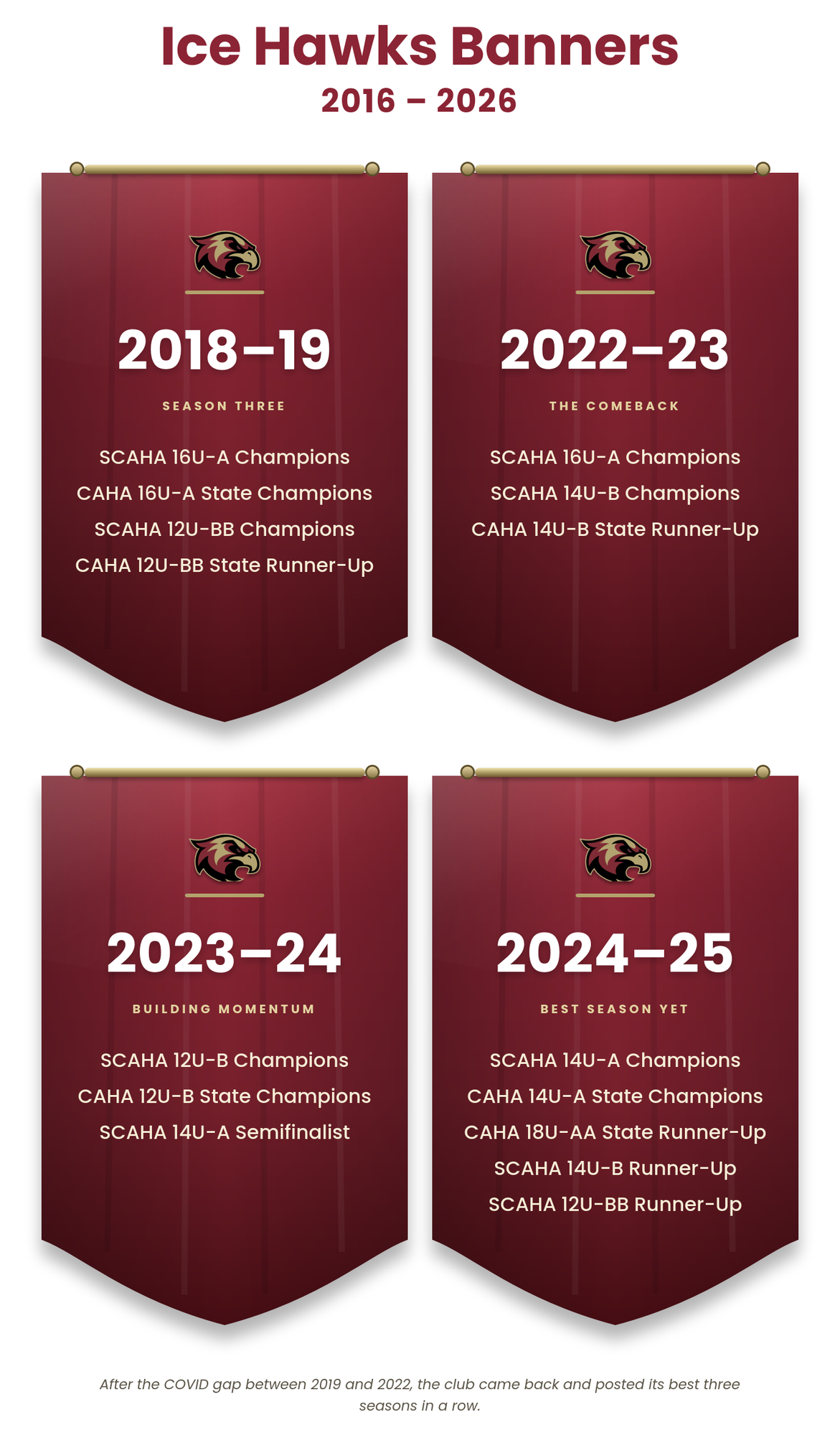
In 2018–19, only its third full season, the Ice Hawks won the SCAHA championship at 16U-A, went on to win the California Amateur Hockey Association (CAHA) state title at the same level, and added a SCAHA championship at 12U-BB with a state runner-up finish behind it. Three seasons removed from a cafe-table conversation, a club from Santa Barbara was beating programs from cities ten times its size, programs with multiple rinks and decades of history.
“We’re drawing from a tiny pool compared to LA or Orange County. To win league and state in year three, that says something about the kids and the families. They earned it.”
Steve Heinze, Director of Coaching
Character Reveals Itself
The Ice Hawks mission statement is one sentence: build character, develop skills, and cultivate team-first concepts within a fun, safe, and positive environment. Behind this mission sits a framework of nine attributes the club uses to evaluate every player, and the first one on the list is not a hockey skill. It is character, followed by sportsmanship, discipline, commitment, and leadership before you get to anything about skating or shooting.
Bryce Wendel, the club’s current president, grew up in Minnesota, where hockey is less a sport than a way of life. He joined the Ice Hawks in 2019 when his oldest started at the mini-mite level, and he came in looking for a specific thing. “Some of my best friends in life, I met on the ice,” he said. “Hockey doesn’t build character, it reveals it pretty quick. You know what kind of person someone is after a few minutes of playing with them. I wanted my kids to grow up inside that, and I wanted to help make sure the club we were building here was that kind of place.”
He has since put two kids through the program, and his third plays 16U-AA this season. He has also coached a lot of winning hockey. His 2024–25 14U-A team won the SCAHA championship and then the CAHA state title, and his teams have won several tournaments across the region. But ask him about the framework and he does not start with the banners.
“The hockey follows the character, not the other way around.”
Bryce Wendel, President
“Sportsmanship, discipline, commitment, leadership. Those aren’t words we put on a poster and forget about,” Bryce said. “They’re how we pick teams, they’re how we coach, they’re how we handle a bad loss on a Sunday in Bakersfield. If a kid is showing up on time, working, and treating his teammates and the refs with respect, that kid is going to develop.”
Jeannie Wendel, Bryce’s wife, a board member, and the team manager for many of those winning teams, has seen the same thing from the bench door and the hotel lobby.
“Those teams won because they liked each other and played for each other. That’s the part you can’t coach into them. You build the environment and they do the rest.”
Jeannie Wendel, Board Member & Team Manager
The change over ten years is easy to state. “When we started, we were all entry-level B teams,” Bryce said. Now kids in Santa Barbara start skating at four or five, spend as much time on the ice as they want at a rink five minutes from home, and get quality coaching from the beginning. “They’re going farther.”
The Year the Ice Melted
Every ten-year story has a chapter nobody planned for. For the Ice Hawks, that chapter was 2020–2021.
When the pandemic hit in March 2020, Ice in Paradise was classified as a gym by the county health department and shut down. The ice was melted down. Steve, who was serving as President of the rink’s board at the time, spent months in what he describes as a battle to keep the doors open. “There were a lot of conversations and heated discussions with the powers that be at the health department about why I couldn’t put ten or fifteen people six feet apart on a hockey rink, but they always said no,” he said. “That was scary for everybody. Trying to decide if we take the ice out? When are we going to open again?”
Bryce had taken over as Ice Hawks president at the end of 2019. His first year in the role became a year of red tape and reopening plans. The club itself was never in financial danger. “We’re a nonprofit,” Bryce said. “None of our livelihoods depend on the club. Every cent that we take in goes into the program, is given out in financial aid or in some other way given back to the program. So our real concern was just the kids.” Johan, who serves as treasurer, put it the same way. “As a club, I never felt like we were in danger. It was definitely more about the survival of the ice rink.”
That distinction mattered. The rink was the club’s home, and without it there would be no club. So the Ice Hawks did what they could, including prepaying for ice time to help keep the facility alive until the doors could open again.
The cost of that COVID year still shows up. “We’re still rebuilding,” Bryce said. “We still have some gaps in these cohort teams from those years where we couldn’t grow the number of kids.” The club’s response was to redouble its focus on the youngest ages, four through six, and rebuild from the bottom up.
The Studio Ice Pipeline
The banners are the visible part. The part that makes them possible happens on the studio rink with five-year-olds who can barely stand up.
Melissa Petersen, the club’s Registrar, describes a pathway that has matured over the past several years into something the founding group could only have hoped for. It starts with Learn to Skate, which the club requires before any child puts on hockey gear. From there, kids move into Young Norqs, an eight-week beginner Learn to Play program named in honor of Jack Norqual, one of the founders and biggest donors of Ice in Paradise. The rink’s studio sheet carries his name too.
“They have no idea how much they’re actually learning. To them, they’re just out there playing games and having fun. That’s exactly what we want at that age.”
Melissa Petersen, Registrar
After Young Norqs comes the Jr. Hawks in-house programs: Mighty Mites, then Minors for roughly ages five to eleven, then Majors for ages twelve to sixteen. These programs feed the Ice Hawks travel teams, but Melissa is clear that they are just as important for kids who never want to play travel hockey at all. The point is the same either way: a fun, safe place to fall in love with the game.
The pipeline is now producing results. “Especially with our younger players, 10U and below, we’re now seeing a lot of kids who started in Learn to Skate before eventually making their way onto an Ice Hawks team,” Melissa said. “It’s really cool to see that progression from a kid learning how to stand up and skate all the way to putting on an Ice Hawks jersey.”
One more trend worth noting: the growth in the number of girls playing hockey. The Ice Hawks have always been co-ed, and girls have played at every age level throughout the club’s history. Johan’s daughter Kennedy played all the way through on the boys’ teams in the early years. Jeannie, whose daughter Addi played through the Ice Hawks, sees it working from the inside. “The club does a great job supporting our girls on co-ed teams,” she said. “Both the boys and the girls get a lot out of it and learn how to treat everyone with respect.” This season, Melissa is seeing more girls than ever at 12U and younger. “They’re getting started earlier, developing their skills and, most importantly, loving hockey.”
It Takes a Village… on Ice
The Ice Hawks have no paid staff. The club runs on a volunteer board of directors, reelected every year, and on the parents who step up around it.
Jeannie remembers when the roster problem was simple: not enough kids. “Early on we didn’t have enough players,” she said. “It was just my kids and their friends trying to form teams. Everyone was just starting out.” Ten years later, the thing she is proudest of is not a banner. “Our club parents are just the best. We routinely get comments from other clubs, in other regions, that our team parents are a great group. Passionate but respectful, with great sportsmanship.”
Bryce shares this sentiment. “It takes people invested in the kids’ futures and with a passion for the game of hockey,” he said. “It’s bringing in different passionate voices with different backgrounds so that we best represent our community on and off the ice.”
Steve, ten years in, is still right there on the ice with the coaching staff. Having a former NHL player run youth clinics and volunteer parent coach training sessions is a rare luxury for a club this size, and it goes a long way toward explaining why Ice Hawks teams play the way they do.
“The kids are only going to be as good as the coaching they get. If I can make our coaches better, I’ve made every kid on their bench better. That’s what I want to do.”
Steve Heinze, Director of Coaching
For him, though, the mission goes beyond strategy. “I want everybody that plays here to know that we’re their community,” he added. “The rink is their safe place, it’s a home away from home. That’s where you build friendships, that’s where you learn lessons.”
The Next Ten Years
Ask the founding group what they want the Ice Hawks to look like in 2036 and a similar theme arises.
“I would love two levels of teams at every age,” Steve said. “Two teams at 18s, two teams at 16s, two teams at 14s, all the way down to in-house. So kids can stay here and not feel like they have to go somewhere else to play at a given level.”
“I’d love it if we could have more than one team at each level,” Johan said, “and if all the people in town knew we were here.”
That wish is about access as much as ambition: a place for the kids who want to push, and a place for the kids who just want to play for fun. Johan’s own son Calvin is the case study. “He was probably the worst player to make the team his first year,” Johan said. “But he loved hockey. He was home in the garage shooting pucks all the time.” Calvin played B hockey most of the way, finished at AA, and led his high school team his senior year. “It wasn’t overwhelming hockey, hockey, hockey. He could still have friends and do different things. I think that’s why what we’re doing really works.”
Bryce wants the same two-team structure, and he is specific about why. “Two teams at every level means every kid has a place, the ones who want to push and the ones who just want to play with their friends,” he said. “But I’m not chasing bigger for its own sake. I want better. Better coaching, better development, and costs that come down instead of up, because the price tag is the biggest thing keeping kids out of this sport.” He wants the club to reach families who have never been inside a rink.
Melissa gets the last word, because she said it best.
“I hope that ten years from now we’re still growing, still trying new things, and still creating opportunities for kids to play hockey and be part of this community. It’s a special thing we have here and it needs to be treated with care.”
Melissa Petersen, Registrar